⏱ 8-10 min read
📅 Updated Jul 2026
🔍 1 Watch Reviewed
Few wristwatches occupy such a singular position in horological history as the Bulova Accutron. Neither fully mechanical nor quartz, the Accutron represents a revolutionary chapter in timekeeping—one defined by innovation, sound, and scientific ambition. Among the most collectible references is the 1976 Bulova Accutron 15 Jewels men’s wristwatch, powered by the Bulova Caliber 2182G electronically controlled tuning fork movement. With its smooth sweeping seconds hand, day/date display, gold-tone dial, and distinctive humming sound, this watch stands as a landmark achievement and a highly prized collector’s item today.


For collectors, historians, and enthusiasts alike, this Accutron stands as a lasting symbol of innovation, bridging the worlds of mechanical tradition and electronic precision in a way no other watch ever has.
📅 Updated Jul 2026
🔍 1 Watch Reviewed

Produced during the final golden years of tuning-fork technology, this Accutron bridges the gap between traditional mechanical watchmaking and the quartz revolution that would soon reshape the industry forever.
The Accutron Legacy: A Revolution in Timekeeping
When Bulova introduced the Accutron in 1960, it was nothing short of revolutionary. Instead of a balance wheel and escapement, the Accutron relied on a 360-Hz tuning fork, regulated electronically. This made it the most accurate wristwatch of its era, far surpassing conventional mechanical movements.
By the time the 2182G movement appeared in the mid-1970s, Accutron technology had reached its most refined and reliable form. These later models benefited from over a decade of technical evolution, improved energy efficiency, and enhanced usability—making the 1976 examples especially desirable among collectors.

The Bulova 2182G Movement: Precision Refined
At the heart of this 1976 Accutron is the Bulova Caliber 2182G, an electronically controlled tuning fork movement featuring 15 jewels. This movement represents a significant improvement over earlier 218 variants.
Key Technical Highlights
• Electronically regulated tuning fork movement
• 360 Hz frequency for exceptional accuracy
• 15 jewels to reduce friction and wear
• Smooth sweeping seconds hand, free of quartz “ticking”
• Signature Accutron hum, produced by the vibrating fork
Unlike mechanical watches that “tick” once per second—or quartz watches that step sharply—the Accutron’s seconds hand glides continuously around the dial, a visual hallmark that still captivates enthusiasts today.
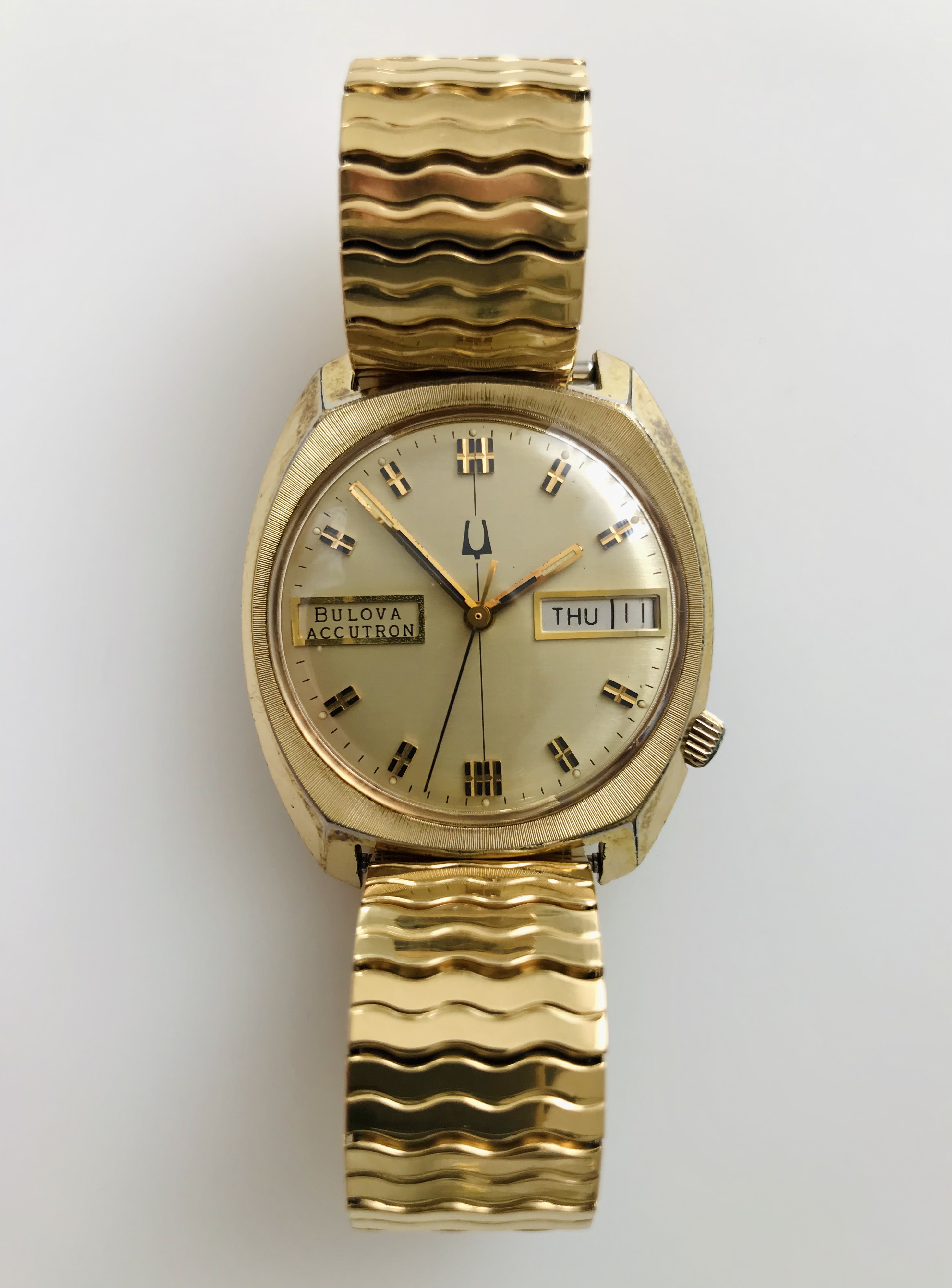
The Special “G” Crown: A Practical Innovation
One of the most distinctive and collectible features of the 2182G Accutron is its special “G” crown, a clever and functional advancement over earlier models.
Battery-Saving Storage Function
When the crown is pulled fully outward, the “G” crown disconnects power from the battery, allowing the watch to be stored without draining energy. This was a major improvement over earlier Accutron movements, which continued consuming power even when not running.
For collectors and vintage watch owners, this feature is especially valuable, as it:
• Preserves battery life
• Reduces unnecessary wear on electronic components
• Makes long-term storage safer and more practical
This thoughtful engineering reflects Bulova’s commitment to real-world usability, not just technical brilliance.

Day/Date Functionality: Elegant and Purposeful
The watch features a day and date complication, neatly integrated into the dial. True to Accutron design philosophy, the day display is adjusted through a natural 18–24 hour cycling of the hands, rather than a quick-set mechanism.
While this may seem unconventional by modern standards, it reinforces the mechanical-electronic hybrid nature of the watch and adds to its period authenticity. For collectors, these quirks are not drawbacks—they are part of the Accutron’s unmistakable charm.
Gold-Tone Dial: Classic 1970s Elegance
Visually, this 1976 Bulova Accutron embodies the refined elegance of mid-1970s design. The gold-tone dial offers warmth, legibility, and a sense of understated luxury that pairs beautifully with the technical sophistication beneath.
Typical features include:
• Clean applied hour markers
• Slim baton or luminous hands
• Subtle Accutron branding
• Balanced day/date window integration
Whether paired with a gold-tone case or complementary bracelet, the dial reflects Bulova’s mastery of both form and function.

The Accutron Hum: A Sound Unlike Any Other
Perhaps the most magical aspect of owning a vintage Accutron is its distinctive humming sound. Instead of ticking, the tuning fork vibrates continuously, producing a soft, almost futuristic hum that can be heard when the watch is held close.
This sound is not merely a novelty—it is audible proof of one of the most ambitious technological experiments in wristwatch history. For many collectors, the hum alone is reason enough to own an Accutron.
A Bridge Between Mechanical and Quartz Timekeeping
The 1976 Bulova Accutron occupies a unique historical position. It represents:
• The culmination of electro-mechanical watchmaking
• A technological bridge between traditional mechanical movements and quartz
• A symbol of mid-20th-century optimism in science and engineering
While quartz would ultimately dominate the market due to cost and efficiency, the Accutron remains unmatched in character, innovation, and emotional appeal.

Collectibility and Market Appeal
Today, vintage Bulova Accutron watches—especially late-production models with the 2182G movement—are highly sought after by collectors.
Why Collectors Prize the 1976 Accutron
• Advanced and reliable tuning fork movement
• Battery-saving “G” crown feature
• Smooth sweeping seconds hand
• Iconic historical importance
• Distinctive auditory experience
• Timeless gold-tone aesthetics
Well-preserved examples with original dials and properly functioning movements continue to rise in value, particularly as fewer watchmakers retain the expertise required to service tuning fork calibers.
Ownership Considerations
While robust, Accutron movements require specialized servicing. Owners should seek experienced technicians familiar with tuning fork technology and use correct modern batteries designed for Accutron calibers.
When properly maintained, a 1976 Accutron remains not only wearable but remarkably accurate—even by modern standards.

Frequently Asked Questions
What movement powers the 1976 Bulova Accutron 15 Jewels watch?
It's powered by the Bulova Caliber 2182G, an electronically controlled tuning fork movement with 15 jewels. The tuning fork vibrates at 360 Hz, which regulates timekeeping far more precisely than a conventional balance wheel.
How is the Accutron different from a mechanical or quartz watch?
Instead of a balance wheel and escapement (mechanical) or a stepping quartz crystal, the Accutron uses an electronically regulated tuning fork. This produces a smooth, continuously sweeping seconds hand rather than a tick or a step, along with the movement's signature audible hum.
What is the special "G" crown on the 2182G Accutron?
The "G" crown is a battery-saving feature: when pulled fully outward, it disconnects the movement from the battery so the watch can be stored without draining power. Earlier Accutron movements kept consuming battery power even when not being worn.
How does the day/date complication work on this watch?
The day display cycles naturally through an 18 to 24 hour hand movement rather than using a quick-set mechanism. It's an unconventional approach by modern standards, but it's true to the Accutron's electro-mechanical hybrid design.
Why does the Accutron make a humming sound?
The tuning fork at the heart of the movement vibrates continuously at 360 Hz to keep time. That vibration produces a soft, futuristic hum that's audible when the watch is held close, and it's one of the most beloved traits among collectors.
What does "15 jewels" mean for this movement?
The 15 jewels are used at key friction points within the movement to reduce wear, which helps improve the caliber's reliability and long-term durability.
When did Bulova first introduce the Accutron?
Bulova introduced the Accutron in 1960. Its electronically regulated 360 Hz tuning fork made it the most accurate wristwatch of its era, far outperforming conventional mechanical movements at the time.
Why are 1976 Bulova Accutron watches with the 2182G movement so collectible?
The 2182G arrived in the mid-1970s after more than a decade of refinements to Accutron technology, making it more reliable and efficient than earlier calibers. Combined with the battery-saving "G" crown, the smooth sweeping hand, and the movement's iconic hum, well-preserved examples are highly sought after today.
What should owners know about maintaining a vintage Accutron?
Accutron movements require specialized servicing, so owners should work with technicians experienced in tuning fork technology and use the correct modern batteries designed for Accutron calibers. Properly maintained, these watches remain wearable and remarkably accurate even today.
What does the dial of the 1976 Bulova Accutron 15 Jewels look like?
It has a gold-tone dial with clean applied hour markers, slim baton or luminous hands, subtle Accutron branding, and a balanced day/date window, reflecting the understated elegance of mid-1970s watch design.
Conclusion: A True Icon of Horological History
The Bulova Accutron 15 Jewels vintage men’s wristwatch from 1976, powered by the 2182G tuning fork movement, is far more than a timepiece—it is a technological milestone. With its smooth sweeping seconds, ingenious battery-saving crown, gold-tone dial, and unmistakable hum, it captures a moment when watchmaking dared to reinvent itself.For collectors, historians, and enthusiasts alike, this Accutron stands as a lasting symbol of innovation, bridging the worlds of mechanical tradition and electronic precision in a way no other watch ever has.


0 Comments